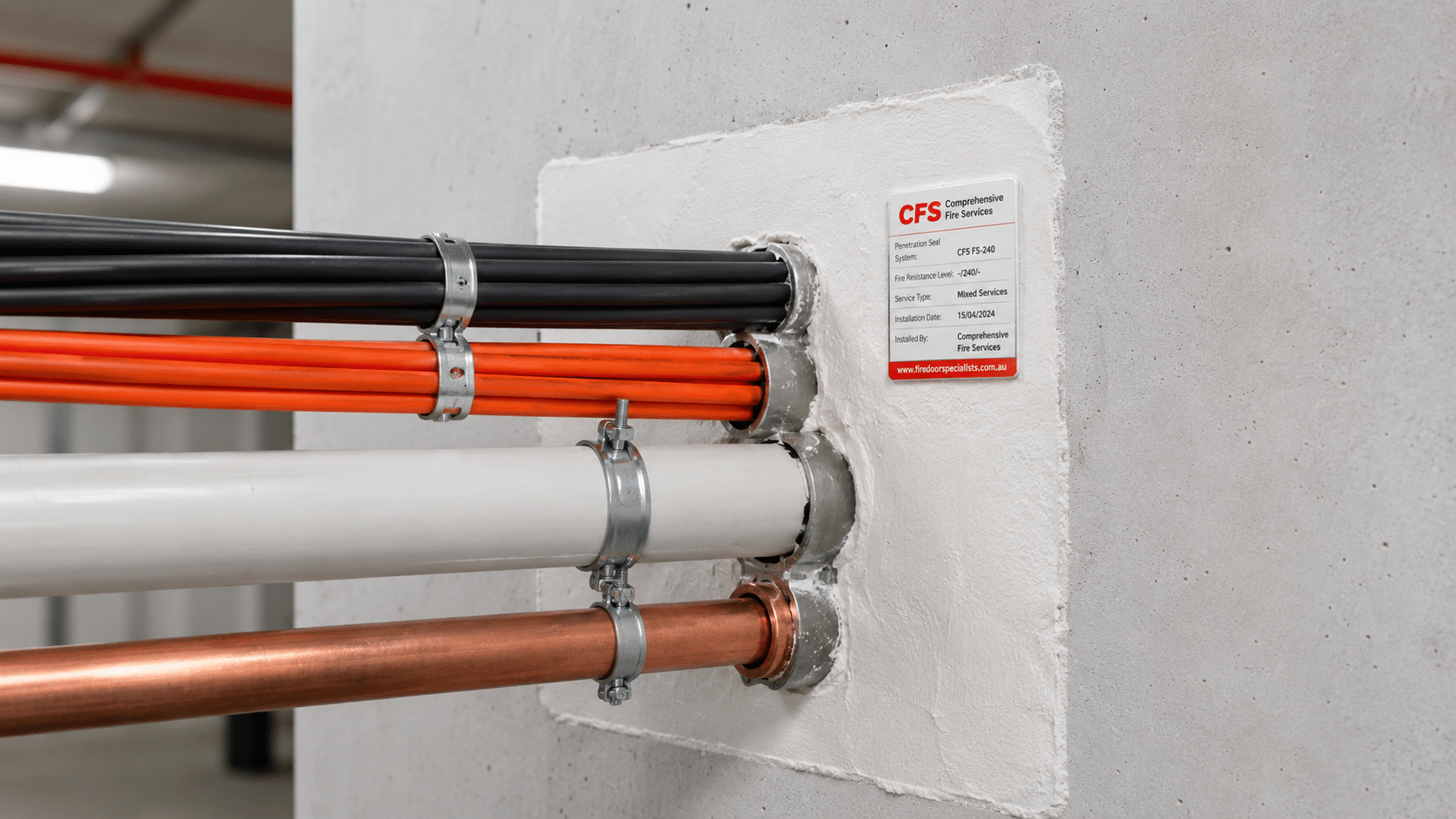
When Cables or Pipes Pass Through a Fire Wall
Cables or pipes pass through fire walls in many commercial, strata and industrial buildings, but the small opening around those services can create a big fire safety problem if it…


If you manage a strata building, commercial property, warehouse, school, or apartment complex, understanding what a fire door label really means can save you time, money, and a whole lot of stress. It can also stop small assumptions from turning into expensive defects later.
Fire door label confusion is more common than most people think. Plenty of people spot a label on the edge of a door and assume that means the door is compliant, certified forever, and ready to pass any inspection without a second glance. That would be nice, but sadly, a label is not a magic pass.
Let’s break it down in plain English.
A fire door label is there to identify that the door assembly was manufactured or tagged as a fire-rated product. In simple terms, it tells you the door was made to meet a tested fire-resisting specification at the time it was produced or installed. That matters because fire doors are designed to slow the spread of fire and smoke, helping protect escape paths and buy people valuable time.
So yes, the label is important. Very important.
But it is only one part of the story.
What a Fire Door Label usually tells you is the door’s fire rating or classification, the manufacturer or approved tagging body, and sometimes a reference number that links the door to a tested system or compliance pathway. Depending on the door type and age, it may also indicate whether the frame or hardware forms part of the approved assembly.
That sounds reassuring, and it is, up to a point.
The problem is that many building managers assume the presence of a fire door label means the whole opening is compliant forever. It does not. A label can tell you what the door started life as, but it cannot tell you what has happened to it since.
And that is where things get interesting.
For example, the label does not tell you whether the door still closes properly. A fire door that sticks open, slams badly, drags on the floor, or does not latch shut may not do its job in a real fire. It also does not confirm whether someone has swapped out approved hardware for something cheaper or easier to source. That innocent-looking lock, closer, seal, or hinge could be the very thing that creates a compliance issue.
A fire door label also does not tell you if the door leaf has been damaged. Holes, cracks, warping, impact damage, unapproved kick plates, dodgy signage fixings, and oversized penetrations can all affect performance. The label may still be sitting there looking official, but the door itself could be in poor shape.
Think of it like a registration plate on a vehicle. It helps identify what the vehicle is, but it does not guarantee the tyres are safe, the brakes work, or the engine is in good condition. Same idea here.
Another thing a fire door label does not confirm is whether the frame, seals, gaps, and hardware still match the tested configuration. Fire doors work as a system, not as a single slab of timber or steel. If the frame has shifted, the smoke seals are missing, the clearances are wrong, or the closer has failed, the label alone cannot rescue that setup.
This is especially important in older buildings, where years of repairs, repainting, tenancy changes, and ad hoc maintenance can slowly alter the opening. One trade drills a hole. Another trims the door. Someone changes the lock. Before long, the door still has its label, but not much else is as it should be.
A fire door label also does not automatically prove the inspection paperwork is current. Building owners and managers often need documented evidence of inspections, maintenance, and repairs, especially when annual compliance obligations roll around. If your records are patchy, the label will not fill in the blanks for you.
How to Use a Fire Door Label the Right Way
So what should you actually do when you find a labelled fire door on site?
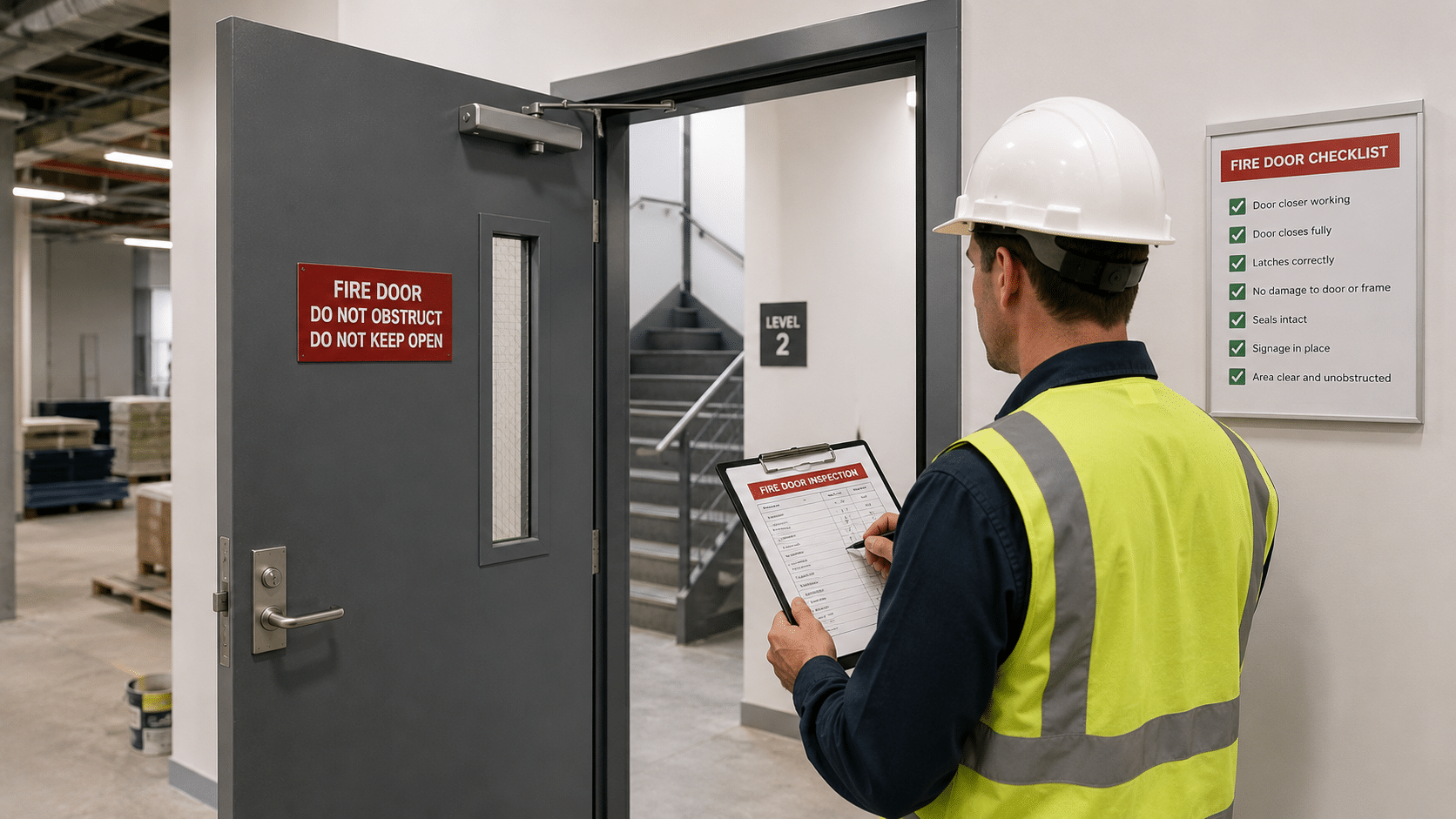
First, treat the label as a starting point, not the final answer. It is useful for identifying the door and understanding the intended fire rating, but it should be backed up by a proper inspection. You want to know whether the whole assembly is in suitable condition and whether it still matches what was originally approved.
Second, do not rely on visual confidence alone. A door can look solid, freshly painted, and perfectly respectable while hiding all sorts of compliance problems. In fact, a fresh coat of paint sometimes makes it harder to spot issues like missing tags, patched holes, or altered components.
Third, pay attention to changes made after installation. Locksmith work, electrical access control additions, ventilation grilles, door viewer installations, and even signage can affect compliance if they are not approved for use with that door system. A fire door label does not give permission for unlimited changes.
One of the biggest misunderstandings is that every labelled door automatically passes inspection. Not true. Another is that if the label is missing, the door is definitely non-compliant. That is not always true either, although it is certainly a red flag. Missing, painted over, damaged, or unreadable labels create identification problems and may require further assessment.
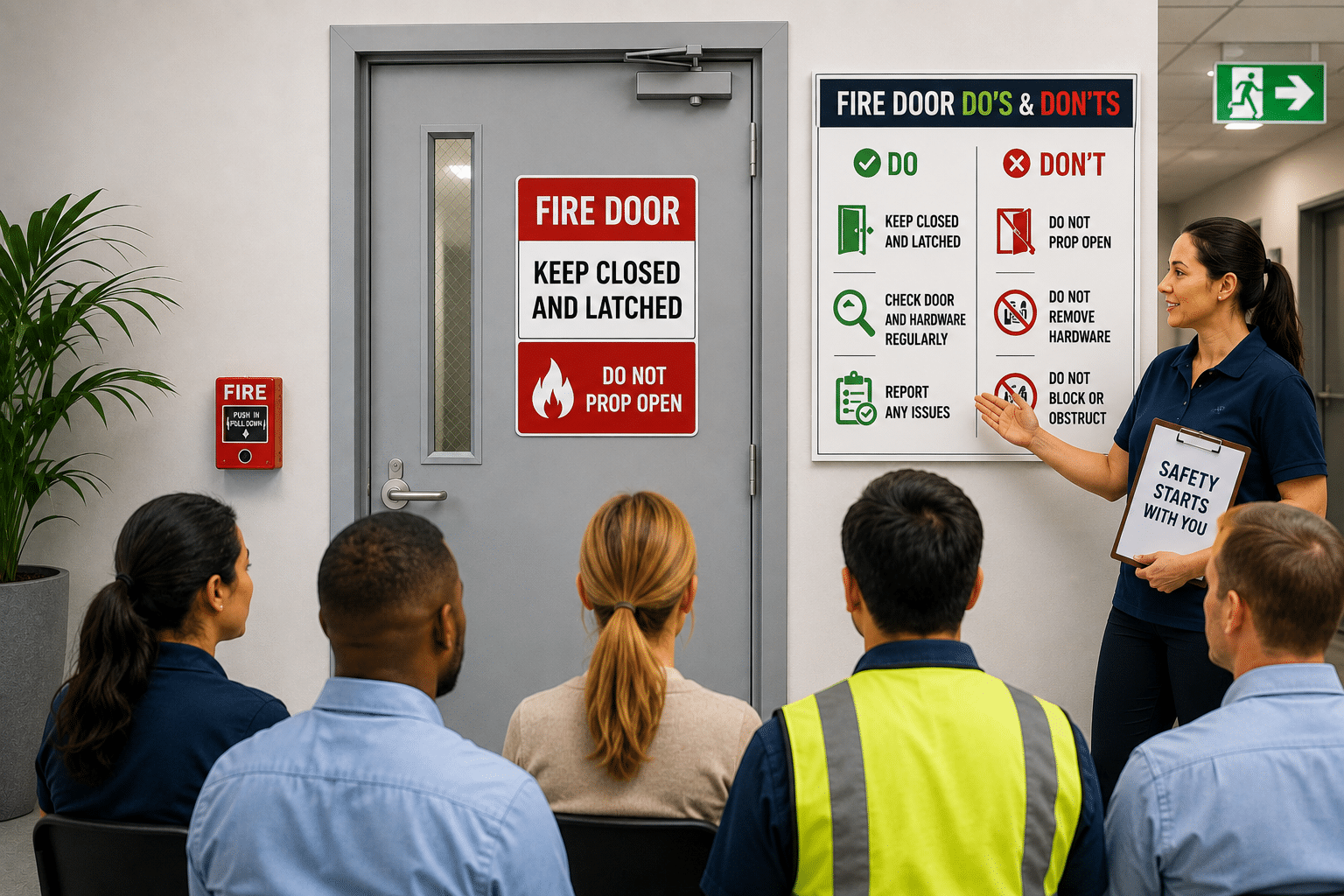
There is also a common belief that a label means no ongoing maintenance is needed. That is wishful thinking. Like any safety feature in a building, fire doors need regular checks to make sure they still work as intended.
A fire door label is important, but it is not the same thing as ongoing compliance, routine maintenance, or professional inspection.
If you are responsible for a building, the real risk is not just misunderstanding the label. The real risk is acting on that misunderstanding. Assuming everything is fine because the label exists can lead to failed inspections, costly rectification work, tenant complaints, or worse, a door that does not perform when it is needed most.
That is why a practical, informed approach matters. Know what the label is for. Respect its value. But do not ask it to do more than it can.
A fire door label tells you the door was identified as part of a fire-rated system. It may give clues about its classification, origin, and intended use. What it does not tell you is whether the door still closes correctly, whether the hardware is approved, whether the gaps are right, whether the seals are intact, or whether the assembly will pass inspection today.
In other words, the label is important, but it is not the whole truth.
For building owners, strata managers, and facility teams, the smartest approach is to see the label as one piece of evidence, not the final verdict. When in doubt, get the door checked properly and keep clear records of inspections and maintenance.
At Comprehensive Fire Services, we help clients inspect, maintain, and manage fire doors so there is less guesswork and more confidence in compliance. If your site has fire doors that need checking, repairing, or replacing, our team can help make the process much simpler.



FPAS Accreditation Number: F055161A
We are committed to delivering the highest level of professionalism and compliance in the fire protection industry. As part of this commitment, our team holds accreditation under the Fire Protection Accreditation Scheme (FPAS) — the national accreditation framework developed by Fire Protection Association Australia (FPA Australia).

Phone: 0418 749 488
Fax: 02 4648 5386
Email: [email protected]
© 2026 Comprehensive Fire Service - Website by BSharp Tech