Warehouse fire doors play a quiet yet vital role in keeping large sites, stock and people safe. If you manage a warehouse, you already juggle forklifts, loading bays and deadlines. Add fire safety to that list and it can feel like a lot. This guide breaks down what matters about shutters, exits and compliance, in plain English, so you can act with confidence.
You are the audience we wrote this for, especially strata, building and facility managers in Sydney and surrounding areas who need reliable, compliant outcomes without fuss. CFS is a local specialist that supplies, installs and maintains certified systems, from solid core doors to hardware and inspections, with an emphasis on quality and compliance.
What exactly are they and why do they matter?
When we say warehouse fire doors, we are talking about doors and shutters that resist fire and smoke for a set time, helping to keep a blaze confined to one section. Think of them as part of the building’s passive fire protection. They do not fight the fire. They slow it down, buy time for people to exit and for firefighters to respond.
In warehouses, door openings tend to be big, traffic is constant and floor plans are open. That means separation between zones is critical. warehouse fire doors are used on compartment lines, between the warehouse and offices, at plant rooms, and around stairwells that act as escape paths.
Shutters for large openings
Roller or sliding fire shutters are common where pallets and vehicles pass through. You get space saving, plus a door that can close automatically during a fire. warehouse fire doors in shutter form are usually held open by a device that releases when a detector, heat link or alarm triggers. They should fall or slide to the closed position smoothly, then stay shut to provide the fire resistance they are rated for.
If you rely on day to day use, test open and close behaviour regularly. Watch for damage from impacts, frayed control cables, loose guides and paint buildup that can hinder movement. warehouse fire doors that do not close properly cannot do their job, even if they carry the right label.
Fire exits and people flow
A door that stops fire still has to let people out quickly. Hardware choices are the key. On escape routes, use compliant levers or panic bars so anyone can exit without a key or special knowledge. For heavy traffic, door closers should be tuned so they close every time yet do not slam. warehouse fire doors on exit paths must never be wedged open with bins, chocks or broom handles. If airflow is an issue, talk to your fire practitioner about hold open units that are fire alarm released and compliant.
Understanding ratings and standards
Australian Standard AS 1905.1 sets construction and performance requirements for fire resistant doorsets. Doors and shutters must be tested and certified to a fire resistance level, for example -/60/30. Choose ratings that match the wall and the risk profile for that part of the building. Labels, tags and certificates are not paperwork for the drawer. They are your proof that the installation is legitimate and traceable.
In practical terms, that means matching the door leaf, frame, seals, hinges, locks and closer as a system. Mixing and matching unapproved parts can void the rating. warehouse fire doors are only as strong as their weakest component, so confirm that your hardware is listed for that doorset.
The warehouse compliance checklist
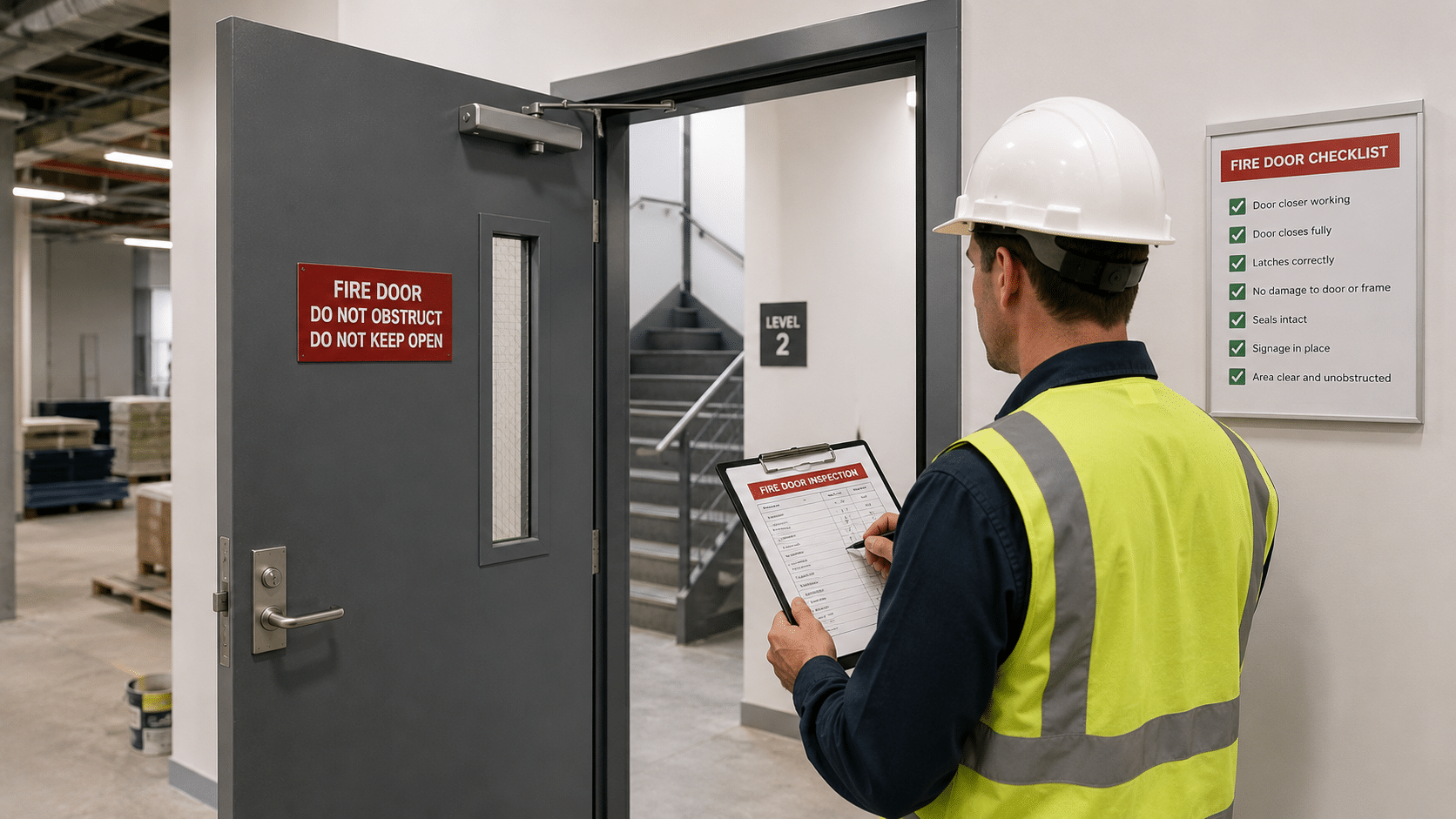
If you like quick wins, run this short check across your site:
- Are door labels present, readable and not painted over
- Do doors and shutters close fully and latch without assistance
- Are gaps within the approved tolerances, especially at the bottom
- Are smoke seals continuous, clean and undamaged
- Is there any unapproved drilling for cabling, vision panels or locks
- Are exit doors free from wedges, chains and stored goods
- Are inspection records current, with defects closed out
Tackle the basics first, then plan repairs for anything that needs a licensed technician. warehouse fire doors respond well to routine maintenance, which is usually far cheaper than last minute fixes before an audit.
Common pitfalls to avoid
The most common issues we see are simple. Paint clogging the door edge. Pallets stacked in the swing arc. Door closers wound right back because staff complained they were heavy. Unrated locks added by a well meaning handyman. A new ramp poured without checking door clearances. warehouse fire doors can slip out of compliance through small changes, so build a habit of quick visual checks as part of your weekly walk.
For shutters, look for missing fusible links, disconnected release cables and dented guides. For swing doors, check that hinges are tight, closer arms are intact and latch bolts are not worn. If a door hits the floor or rubs the frame, it will not close properly. That is a red flag.
Documentation and the AFSS
In NSW, your Annual Fire Safety Statement relies on evidence. Keep a tidy folder for certificates, test reports and inspection records. warehouse fire doors should have installation certificates and ongoing service logs. If you change a door leaf, frame or hardware, update the files. Auditors do not enjoy a treasure hunt and neither do you when the clock is ticking.
Budget friendly ways to stay compliant
You do not need to replace everything at once. Start with the life safety items on egress routes, then move to compartment lines. Simple repairs, like reseating seals, adjusting closers and replacing worn latches, deliver big risk reduction for little cost. Ask your provider to bundle minor works during scheduled visits. warehouse fire doors that are looked after on a smart schedule last longer and perform better.
When to call a specialist
Call a licensed fire door professional if a door is physically damaged, does not close and latch, has missing labels, or if you plan layout changes that affect walls and openings. Engaging early avoids rework. A quick site walk can confirm whether a shutter needs a new release, a door needs certified hardware, or a frame needs replacement.
How CFS can help
Comprehensive Fire Services is a Sydney based team that supplies, installs and maintains certified doors, shutters and hardware. We carry out inspections, issue reports that support your AFSS, and complete repairs with approved components. If you manage multiple sites, we can set up a maintenance program that keeps your warehouse fire doors in shape year round, while giving you clear documentation for audits. Speak with our team for practical advice tailored to your building and risk profile.
Call to action:
Call 0418 749 488 or visit our Contact page to book an inspection.