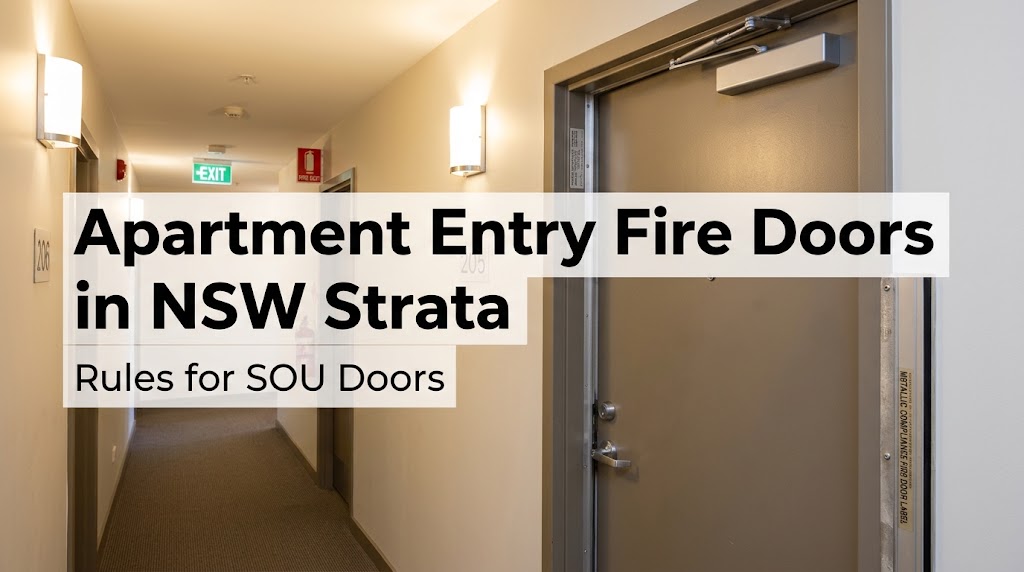
Apartment fire door regulations NSW apply to the front door of almost every unit in a strata building. In most buildings that door is a fire door: a rated, self-closing door that has to stay that way, which means owners can’t freely swap it, drill it or paint over its seals. If it’s damaged or has been replaced with a standard door, it can put the whole building’s fire safety measures out of compliance.
This guide explains what an apartment entry (SOU) door must be, what owners can and can’t change, and what usually goes wrong. For who is responsible, see our guide to fire doors in strata buildings.
Key takeaways on apartment fire door regulations NSW owners should know
Most apartment entry doors in NSW strata buildings are fire doors, so the apartment fire door regulations NSW buildings follow apply to them.
The door must be a tested, rated door set that closes and latches by itself every time.
Painting seals, drilling holes or fitting unrated locks can break the rating.
Responsibility depends on your strata scheme, so check your by-laws.
If you’re unsure, get the door checked before you change anything.
What an SOU door is
SOU stands for sole-occupancy unit. It’s the NCC’s term for a self-contained part of a building, such as an apartment, that is occupied by one household or tenant. The SOU door is the entry door that separates the apartment from the common corridor or lobby.
That door matters because the walls and floors around an apartment are built to contain a fire, and a door is the weakest point in that barrier. If the door isn’t up to standard, smoke and fire can spread into the corridor, which is the escape route for everyone else in the building.
Apartment fire door regulations NSW: what the door must be
The exact requirement depends on the building’s design, but an apartment entry fire door is generally expected to be:
Fire rated. A tested door set (leaf, frame and hardware) with an FRL appropriate to the wall it sits in. Entry doors are commonly rated -/60/30. Our guide to fire door ratings explains what that means.
Self-closing. It must close and latch by itself every time, so a door that is left ajar or won’t latch is non-compliant.
Fitted with the right seals. Fire and smoke seals around the frame, in good condition and not painted over.
Tagged and traceable. A tag or label identifying it as a fire door, in line with AS1905.1.
Check the door against the building’s approved plans and your fire safety records for the specific requirement.
What owners can and can’t change
Because the door is part of the building’s fire safety measures, changes that might look cosmetic can breach the apartment fire door regulations NSW owners corporations must follow. As a general guide:
Change
Usually OK?
What to watch
Repainting the door
Often yes
Don’t paint seals, tags or hinges, and keep coats thin so gaps don’t close up.
Changing the handle or lockset
Only if compliant
Hardware must be suitable for the fire rating. Unrated locks or drilled holes can void the rating.
Must be a fire-rated device. Drilling an unrated hole breaks the door’s rating.
Removing the closer
No
A door that doesn’t self-close isn’t a compliant fire door.
Replacing the whole door
Only with an approved rated door set
A standard door in the same frame is not a fire door.
Owners should get approval from their owners corporation before changing the door, as strata by-laws and the building’s fire safety obligations usually apply. Skipping this step is a common way owners end up in breach.
Who is responsible under apartment fire door regulations NSW?
Responsibility for an apartment entry fire door can depend on how your strata scheme is set up, and whether the door is treated as common property or lot property. In many buildings the owners corporation carries the obligation to keep essential fire safety measures, including fire doors, maintained and certified each year. Owners are usually responsible for not damaging or altering the door. Whoever is responsible, the door itself still has to meet the same standard.
This is general information, not legal advice. For the full picture, see who is responsible for fire doors in strata, check your scheme’s by-laws and strata plan, or ask a strata lawyer.
How to check your apartment fire door in five minutes
You can spot most problems yourself. This isn’t a substitute for a formal inspection, but it shows whether your door is likely to meet the apartment fire door regulations NSW buildings are audited against.
Find the tag. Look on the door edge or frame for a fire door tag or label.
Test the closing. Open the door halfway and let go. It should close and latch on its own.
Check the seals. The seals around the frame should be continuous, undamaged and unpainted.
Common breaches of apartment fire door regulations NSW
Door doesn’t close fully or latch because the closer is missing, broken or set too weak.
Smoke or fire seals painted over, damaged or missing.
Door replaced with a non-rated door, often during renovations.
Large gaps around the door, or the door rubbing on the frame.
Tag removed or painted over, so the door can’t be verified as rated.
Holes drilled for peepholes, locks or smart devices.
Regular inspections catch most of these problems before they become an audit failure. See our guide to fire door inspections for what a proper check involves, and repair or replace if a door is past fixing.
What happens if an apartment fire door doesn’t comply
A non-compliant entry door is a defect in the building’s essential fire safety measures. It can be flagged during inspections and when the annual fire safety statement is prepared, and it may have to be fixed at the owners corporation’s or the owner’s cost, depending on who is responsible. In a fire, a faulty door lets smoke and flames into the corridor that everyone else uses to escape.
Fixing a problem early, such as adjusting a closer or replacing a damaged seal, is usually less disruptive than replacing a whole door. See repair or replace.
Apartment fire door regulations NSW: frequently asked questions
Do apartment fire door regulations NSW require my front door to be a fire door?
In most NSW apartment buildings, yes. Under the fire safety rules for apartments in NSW, entry doors separating units from shared corridors are usually required to be fire-rated and self-closing, but check your building’s approved plans.
Can I change my apartment’s front door?
Not freely. Replacing it with anything other than an approved rated door set can breach fire safety requirements. Get your owners corporation’s approval first and use a qualified provider.
Who pays to repair an apartment fire door?
It depends on whether the door is common property or lot property under your strata scheme, and what caused the damage. Check your strata plan and by-laws.
Can I put a deadbolt or smart lock on my apartment fire door?
Only if it’s suitable for a fire door, doesn’t stop the door closing and latching, and allows people to leave without a key. Check with a fire door specialist before drilling.
How do I know if my apartment door is fire rated?
Look for a tag on the door edge or frame, then check the building’s plans and fire safety records. If there’s no tag and no records, get the door assessed.
Need an apartment fire door checked or replaced?
Not sure which apartment fire door regulations NSW buildings must meet? Comprehensive Fire Services works with strata managers and owners corporations across Sydney to inspect, repair and replace fire doors. Find out about our strata fire door services.
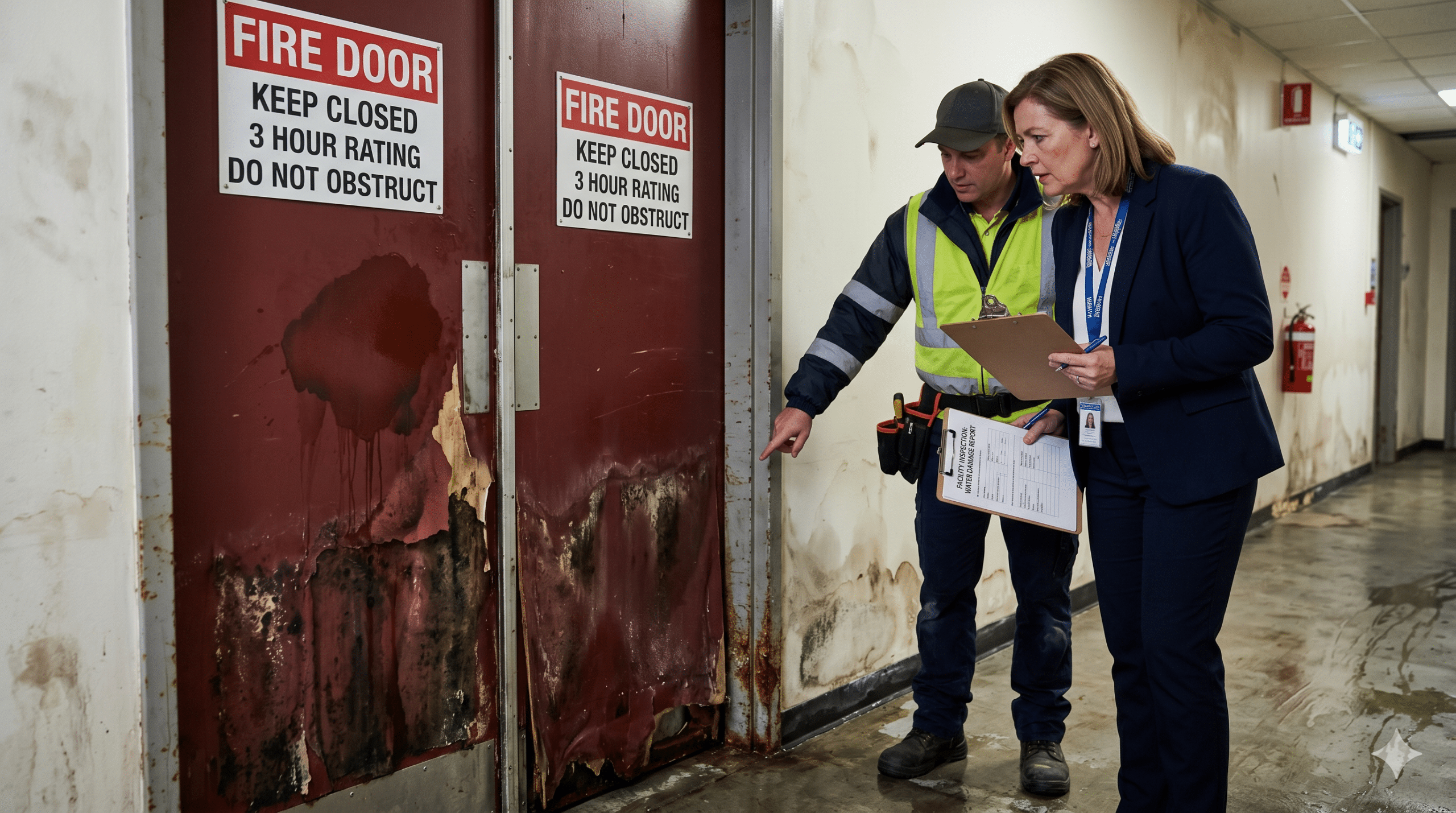
Water damaged fire doors are a serious compliance risk that building managers in Sydney cannot afford to overlook. Whether caused by a burst pipe, flooding in a basement carpark, a…
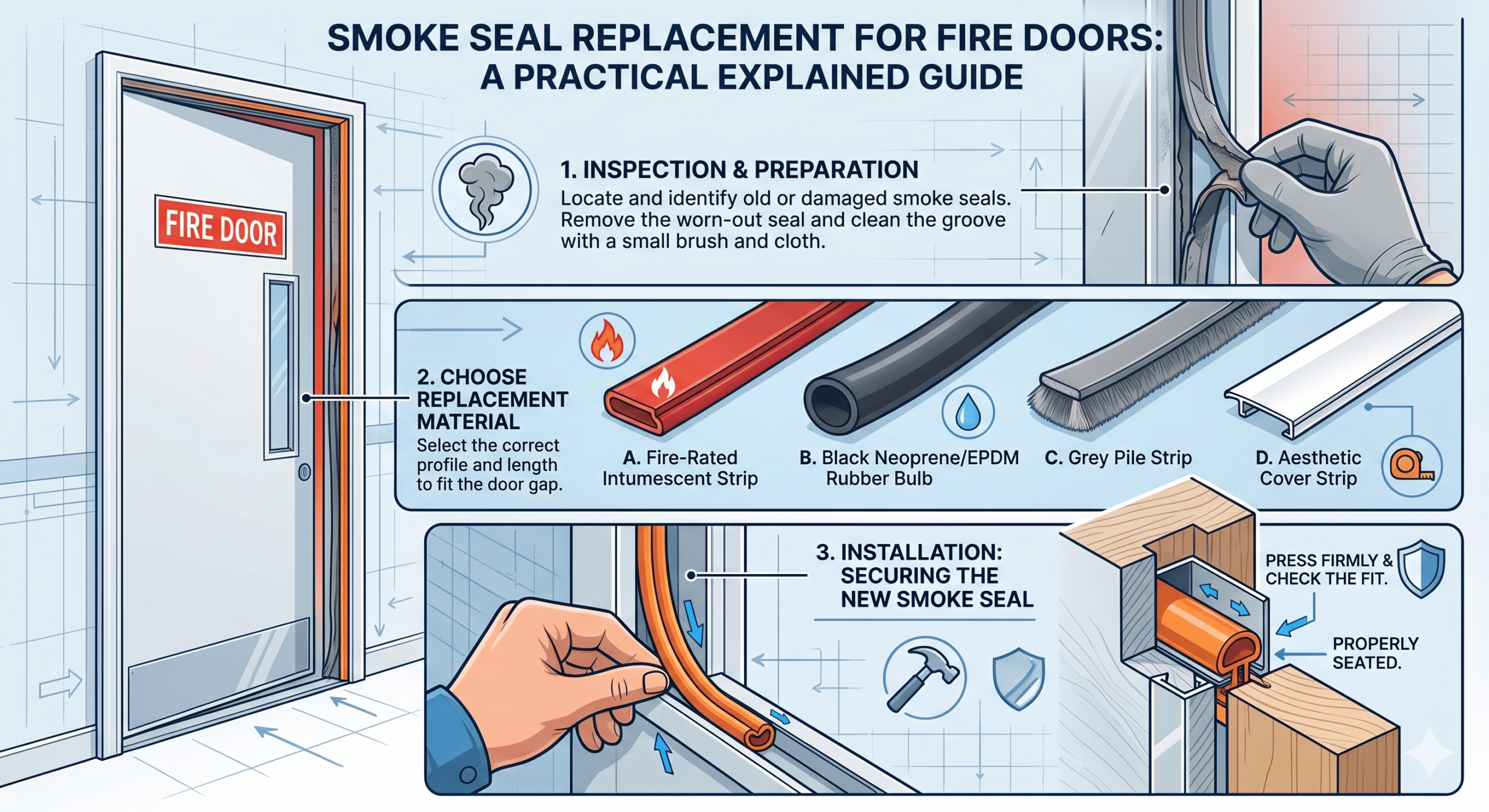
Smoke seal replacement is one of the most common maintenance tasks identified during fire door inspections in Sydney buildings, yet it is also one of the most frequently deferred. Smoke…
Joe has always demonstrated to be professional, reliable and detailed with his work.
His broad knowledge, exceptional service and attention to detail means jobs appointed are always done to a very high level of standard.
We would highly recommend utilising Joe’s experience and expertise for your building or home maintenance and repairs.
Comprehensive Fire Services are the specialists for Fire Door installation and rectification. Joes in depth knowledge of building codes and installation standards is an asset as when doing a job, its done right. I’ve had nothing but a positive experience with the team at CFS with them completing 500+ jobs for our business, the quality of work and attention to detail is second to none. I highly recommend there services!
Joe has helped me with several installations and repairs of fire doors and passive fire systems. He is always on time, quotes are prompt, and the work is always exceptional (especially his doors!). Would recommend his services to anyone.
I have been working with Comprehensive Fire Services since 2012, there knowledge, expertise and quality workmanship and attention to detail is amazing.
Always on time, site is always left clean at the end of each job.
There is no other team I would use.
I would highly recommend CFS if you want the job done right.
SPM Facilities Management
Outstanding Service
Highly recommend Comprehensive Fire Services. There work is always of high quality, along with impeccable customer service.
FPAS Accreditation
FPAS Accreditation Number: F055161A
We are committed to delivering the highest level of professionalism and compliance in the fire protection industry. As part of this commitment, our team holds accreditation under the Fire Protection Accreditation Scheme (FPAS) — the national accreditation framework developed by Fire Protection Association Australia (FPA Australia).
Comprehensive Fire Services Office
Contact Us
Please feel free to contact us via the form below, or call our office on 0418 749 488